Global OEM & Industrial Supply Standard

Top Trusted Wireless Battery Management System Manufacturers & Exporters

Engineered for Next-Generation Lithium-Ion, LiFePO4, and LTO Battery Assemblies Across Electric Mobility, ESS, Robotics, and Aerospace Systems.

Leading Wireless & Smart BMS Commercial Solutions

Explore our top-tier export-grade Wireless Intelligent Battery Management Modules, Coulomb Meters, and Bluetooth/Wi-Fi Integrated Smart PCBA Units designed for severe OEM operational envelopes.
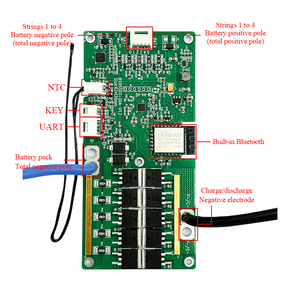
YDE 3S 12V Wireless Intelligent Battery Management System BMS

YDE 3S 12V 30/60A Wireless Intelligent Battery Management System BMS Monitoring System Lipo Battery Balancer Bms Pcba

  • Voltage / Configuration: 3S 12V Architecture
  • Continuous Discharge: 30A / 60A Peak
  • Wireless Monitoring & Active Balancing
Send an Inquiry
JBD Smart Home Energy Storage BMS UP16S019

JBD Smart Home Energy Storage BMS UP16S019 Built-in BT Wi-Fi for 8S 24V 16S 48V LiFePo4 Battery 100A-200A

  • Dual Wireless: Integrated Bluetooth & Wi-Fi
  • Supports 8S 24V to 16S 48V LiFePO4
  • High-Current Handling: 100A - 200A Continuous
Send an Inquiry
VAC8810F Wireless Coulomb Meter BMS Monitor

VAC8810F 2.4" Color Screen Wireless Voltage Ammeter Coulomb Battery Management System 120V/500V (50A-500A)

  • Wireless 2.4-inch Color Display Module
  • Wide Voltage Spectrum: Up to 500V
  • Precision Coulomb Counting & Telemetry
Send an Inquiry
App Smart Monitor 48V 15S BMS 60A Wireless Adjuster Board

App Smart Monitor 48V 15S BMS 60A Battery Management System Wireless Adjuster Board for Outdoor Power Station

  • App-enabled Wireless Real-time Control
  • Optimized for 48V 15S Battery Arrays
  • Ideal for Mobile & Outdoor Power Stations
Send an Inquiry
Tianpower Smart BMS 8S-16S 24V 48V 300A ESS

Tianpower 8S-16S 24V 48V 100A-300A ESS Home Energy Storage Smart BMS LiFePO4/Li-ion with Wi-Fi BT 48200-LT-55

  • Multi-Cell Compatibility: 8S to 16S Scalable
  • Heavy Commercial Rating: 100A to 300A
  • Wi-Fi & BT Dual Dynamic Communication
Send an Inquiry
LWS Solar LED Lights 4S 10A Wireless Charger BMS Module

LWS Solar Led Lights 4S 10A Wireless Charger 12.8V BMS Power Bank Module Board Battery Balancer BMS

  • Custom 4S 12.8V Dedicated Balancing
  • Integrated Wireless Charging Circuitry
  • Designed for Solar, IoT & Remote Power Packs
Send an Inquiry
Jiabaida Balcony Energy Storage Smart BMS

Jiabaida Balcony Energy Storage Battery Management System 8S 24V 15S 16S 48V 50A 100A ESS Smart BMS (RS485 CAN Wi-Fi BT)

  • Comprehensive Bus Interface: CAN, RS485, BT, Wi-Fi
  • Designed for Micro-Grid & Balcony ESS Packs
  • Precision Cell Protection Protocols
Send an Inquiry
TP5100 Lithium Battery Charging Management Module

New Original TP5100 Lithium Battery Charging Management Module Wireless Module Board for OEM Custom Integration

  • Dual Cell Step-Down Switching Controller
  • Compact Footprint for Embedded Subsystems
  • High-Efficiency RF & Power Charging Core
Send an Inquiry
99.98%
Packet Signal Reliability
-35%
Harness Weight Reduction
ISO9001
2015 UK Standard Certified
< 2ms
RF Dynamic Latency

Executive Industry Whitepaper: The Paradigm Shift to Wireless BMS (wBMS) Architecture

The global transition toward high-density energy storage systems (ESS) and high-voltage electric mobility platforms has exposed critical limitations in conventional wired Battery Management Systems (BMS). As battery packs scale from kilowatt-hours to megawatt-hours, physical copper wire harnesses, multipin connectors, and manual assembly configurations introduce point-of-failure vulnerabilities, elevated production labor costs, and significant volumetric weight penalties.

Wireless Battery Management Systems (wBMS) represent a disruptive architectural leap. By replacing physical telemetry harnesses with localized, ultra-low-latency 2.4 GHz wireless mesh networks or proprietary 802.15.4/BLE 5.2 protocol stacks, top manufacturers enable robust cell monitoring while eliminating up to 90% of internal pack cabling. This engineering shift yields higher gravimetric energy density, simplifies automated pack assembly, and streamlines secondary battery lifecycle management.

Key Engineering Value Metric: Deploying a qualified Wireless BMS architecture reduces battery pack wiring harness mass by 30% to 50%, improves spatial utilization by up to 15%, and eliminates primary failure modes stemming from pin fretting, terminal oxidation, and vibration-induced cable fatigue in heavy industrial machinery.

Architectural Analysis: Wired BMS vs. Next-Gen Wireless BMS (wBMS)

Evaluating procurement criteria for tier-1 OEM integration requires comparing the trade-offs between traditional hardwired daisy-chain architectures and modern wireless node networks. The following comparison matrix details critical operational vector metrics analyzed by our engineering team:

Evaluation Vector Traditional Wired BMS Industrial Wireless BMS (wBMS) Strategic OEM Advantage
Harness & Cabling Weight High (Heavy multi-conductor copper looms) Near-Zero (Localized RF Nodes) +5% to +10% Overall Pack Energy Density
Assembly & Manufacturing Labor Manual routing, pin insertion, and crimping Automated robotic module drop-in Up to 40% Reduction in Assembly Time
Vibration & Mechanical Fatigue Connector fretting, wire insulation wear Solid-state potted wireless sensor nodes Significantly Lower Field Maintenance Claims
Scalability & Modularization Fixed cell counts limited by master harness Dynamic module discovery (8S to 400S+) Single BMS Platform across multiple vehicle lines
Second-Life & Recycling Complex harness disassembly required Direct wireless module diagnostic reading Streamlined repurposing for grid ESS applications
Cybersecurity Protocols Physical bus tap vulnerability (CAN/CAN-FD) AES-128/256 Hardware Encryption & PKI Military-Grade Data Protection and Security

Global Sourcing Trends & Procurement Insights (2025–2030)

As international supply chains adapt to aggressive electrification mandates, global procurement directors and technical directors must align component specifications with emerging regulatory and operational standards. Industry trends reveal three major shifts defining future contract awards:

ISO9001:2015 Certified UK BMS Engineering & Export Authority

Backing every shipment with world-class engineering, custom firmware validation, and end-to-end battery integration support for high-stakes OEM projects.

ISO9001:2015 Certified Manufacturing

All design, testing, assembly, and quality validation processes are conducted under strict ISO9001:2015 quality systems in our UK facility. Every BMS assembly undergoes automated functional validation, thermal stress profiling, and RF packet inspection prior to international export dispatch.

Universal Battery Chemistry Platform

Our intelligent wireless BMS and balancing modules offer native software algorithm support across all major lithium chemistry matrices: Lithium Iron Phosphate (LiFePO4 / LFP), Nickel Manganese Cobalt (NMC), and Lithium Titanate Oxide (LTO), enabling seamless deployment across diverse cell formats (pouch, cylindrical, prismatic).

Proprietary AlterVU Configuration Suite

OEM customers gain access to our zero-license-fee AlterVU BMS configuration software. Configure hundreds of telemetry parameters, modify protection thresholds, verify live cell balancing metrics, and execute real-time fault diagnostics across custom wireless battery configurations effortlessly.

Frequently Asked Procurement & Engineering Questions

Addressing key technical, compliance, and integration inquiries from global battery pack designers and procurement teams.

Q: How does a Wireless BMS overcome RF signal interference inside metallic battery enclosures?
Modern industrial wireless BMS units utilize frequency-hopping spread spectrum (FHSS) techniques combined with 2.4 GHz ultra-low power IEEE 802.15.4e mesh topologies or BLE 5.2 extended range protocols. By utilizing multi-path spatial diversity and internal ceramic chip antennas optimized for metallic reflections, signal packet success rates exceed 99.999% even inside fully enclosed aluminum or steel battery cases.
Q: What are the safety latency response times during an over-voltage or over-temperature fault?
While telemetry data streams at configured intervals (e.g., 100ms), safety-critical fault signals (such as hard thermal runaway warnings or short-circuit detection) utilize dedicated high-priority interrupt channels. The wireless latency for critical disconnect triggers is under 2 milliseconds, meeting or exceeding traditional wired CAN-bus propagation standards required by ISO 26262 ASIL-D functional safety specifications.
Q: Can these wireless BMS modules be customized for non-standard voltage ranges and cell configurations?
Yes. Our UK engineering team specializes in custom hardware modification, custom PCB layout, and bespoke firmware engineering. Whether your project requires low-voltage 3S/4S configurations for mobile robotics or high-voltage 16S/32S/100S+ scalable arrays for commercial grid ESS, we offer full turnkey development from prototype design to mass production export.
Q: How are wireless BMS nodes protected against cyber threats and unauthorized data interception?
All RF communications between module sensor nodes and the central manager board utilize hardware-accelerated AES-128/256-bit encryption with dynamic session keys. Additionally, secure public-key cryptography (PKI) prevents unauthorized firmware flashing, ensuring absolute data integrity against unauthorized physical or remote bus intrusion.
Q: What certifications do your exported BMS components carry for international markets?
Our products are designed and manufactured in alignment with CE, FCC, RoHS, and UN38.3 regulatory guidelines. Manufacturing facilities adhere strictly to ISO9001:2015 quality standards, ensuring smooth customs compliance, product traceability, and certification readiness for European, North American, and Asia-Pacific market entry.
Q: What is the typical lead time for custom OEM BMS prototypes and bulk export orders?
Standard stock hardware modules are available for immediate sample dispatch within 3–5 working days. Custom hardware design or tailored firmware integration projects typically complete initial prototype validation in 4–6 weeks, with bulk production scaling to thousands of units depending on customer delivery schedules.

Partner with a Leading Wireless BMS Manufacturer & Exporter

Consult with our UK battery engineering team today to review your project schematics, request product datasheets, or order custom evaluation samples for your next-generation battery project.